


It is technically well-known that the welded frames may have structural unexpected values and problems, while the four columns
configuration guarantees tensional uniformity at all load levels.
Matest manufactures compression machines four columns frame only, and supplies two basic frame designs:
MACHINES WITH FOUR COLUMNS PRESTRESSED FRAME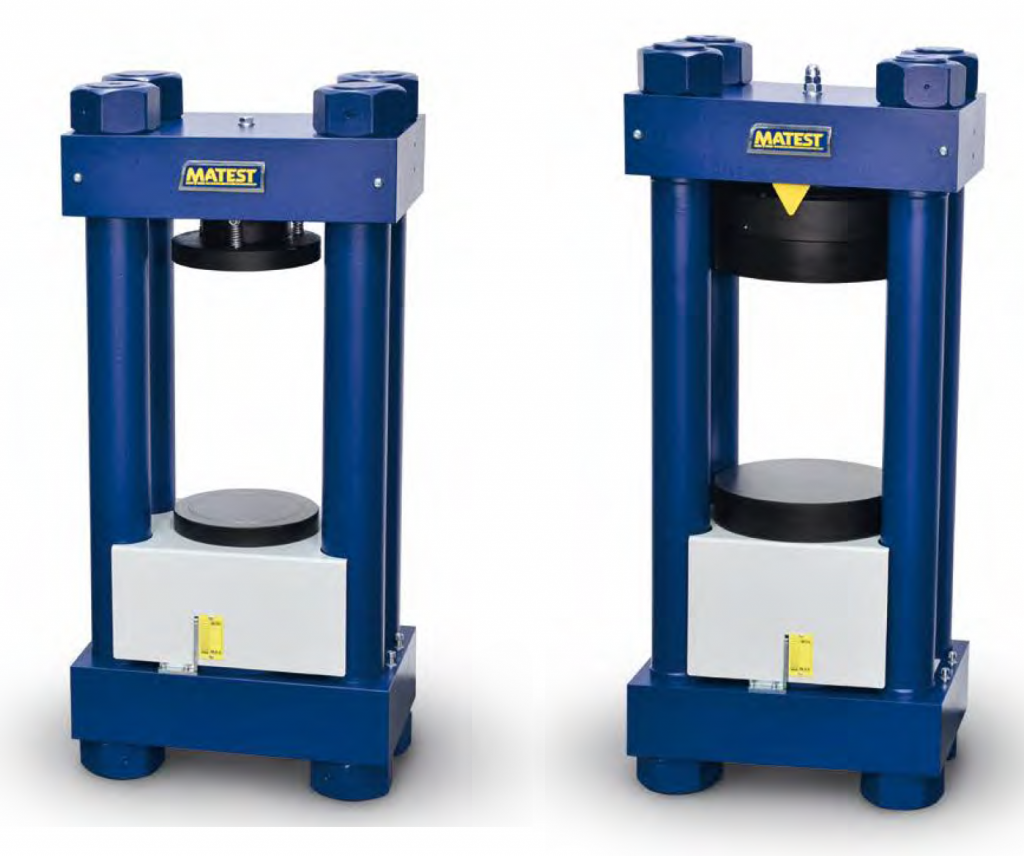
STANDARDS: ASTM C39 | BS 1610 | NF P18-411
AASHTO T22
Models described at p. 230…259
MACHINES WITH FOUR COLUMNS
TESTED FOR HIGH STABILITY FRAME
STANDARDS: EN 12390-4 | BS 1881 | DIN 51220
Models described at p. 261…281
MAIN FEATURES
Extremely strong and oversized load frame ensuring high rigidity and stability.
Precision lapped upper ball-seat with compression platen.
Compression platens are ground finish and surface hardened over 55 HRC.
Designed to meet International Specifications: EN, ASTM, AASHTO, BS, NF, DIN.
Available with 1300kN, 1500kN, 2000kN, 3000kN, 4000kN, 5000kN capacity to test cubes, cylinders and blocks.
Both hand-operated and motorized versions with one or two gauges.
Hydraulic device to stop the piston’s stroke at its max excursion to avoid pumping the piston out of the cylinder.
Available with automatic digital servo-controlled console and electronic digital display measuring system.
Optional safety guards.
HYDRAULIC SYSTEM
Piston has a large diameter: this allows the hydraulic circuit to work at low pressure with a longer
life of the working components and higher precision in the results. Piston is ground and lapped,
and a high quality packing set of three elements is used. Motorized models are equipped with a
dial device to display, pre-select and control the flow allowing an uniform load rate as requested by
the Standards. A fast approach ram action device avoids dead times during the stroke of the ram.
Power pump is multipiston, assuring continuity of delivery, now with improved performances
and more silent.
A movement indicator shows instant by instant the piston excursion during the compression test.
A hopper covering the piston is conceived to avoid the powder of the broken specimen to enter into
the cylinder of the press and damage the packing set.


